"Blackfish" Documentary:
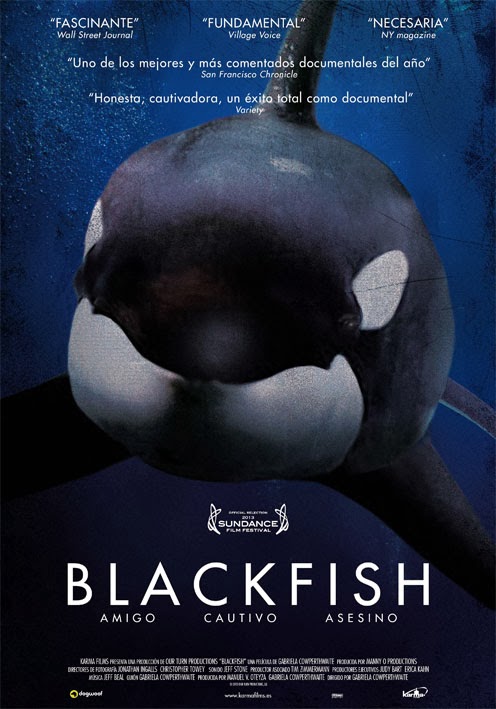
In today's lesson we watched the documentary "Black Fish" which is about SeaWorld in America and its mistreatment of their animals, specifically the killer whales that they have. We looked at the codes and conventions of it in preparation of our new project.
What are codes?
- There are 2 different types of codes- technical and symbolic. Some codes fit both categories, such as music
- A system of signs
- They create meaning withing a media text, e.g. camera angles in a film
- Symbolic codes show what is beneath the surface of what we see, e.g. characters actions show what they're feeling
- Some examples of technical codes are editing, lighting, and camera shots.
- Some examples of symbolic codes are character expressions, mise en scene, acting, colour, and setting.
What are conventions?
- They are generally accepted ways of doing something
- It is closely connected to audience expectations of a media product
- Form conventions: the certain way we expect codes to be arranged
- Story conventions:common narrative structure and understandings that are common in story telling
- Genre conventions:common use of tropes, characters, settings or themes in a particular type of medium
Purpose of a documentary: Michael Renov
- Records, reveals, presents
- Persuades or promotes
- Analyse or interrogates
- Expresses emotions
Conventions of a documentary:
- Actuality
- Archival footage
- Voice over
- Direct and indirect interviews
- Different opinions
- Re-enactments (set ups)
- Montage
- Exposition
The documentary "Black Fish" uses a lot of different documentary techniques and codes and conventions. Some of these documentary techniques that were used include:
- Interviews
- Archival footage
- Montage
- Archetypal characters
- Dialogue
- Voice over
- Inter-cuts
- Establishing shot
- Point-of-view shot
A lot of the interviews were from previous trainers from SeaWorld who have now left after learning about the treatment of the animals and the lies that SeaWorld were feeding them as well as the general public about incidents that happened within SeaWorld, such as trainers being killed/injured by the whales.
It shows how deceitful SeaWorld really is and how they don't really care for the animals or the workers, evident in the fact that they're not willing to tell people the truth about what really happened to those who were killed or hurt.
SeaWorld is portrayed as a family friendly place that rescues whales and other sea animals to give them a better life in captivity, but the documentary shows that they actually get forcibly removed from their homes and family and transported around the world to be put into captivity. The enclosures in which they life are cramped and don't give them enough room to comfortably swim around, so they often come out scratched and hurt from the other whales around them as they are all agitated and frustrated about their situation.
Many of the previous workers were not aware at the time about most of the things that were happening within SeaWorld, so they didn't do anything about it. The documentary shows various news reports and articles of the incidents that took place, most of them with misleading information which makes it sound like it was always the trainers fault for doing something wrong with the animals, when in actual fact it was the animals as they were agitated and lashed out on their trainers. By being in captivity they
What are modes?
Notes:
Here's a link to a practice interview I did with my friend using these questions.
The reason why I asked my friend was to see what her views of mental health are. She herself does not struggle with any mental illnesses so I thought it would be interesting to see her understanding of the subject and see how she's seen others who are affected by it.
I think it went fairly well, although I would've like to have asked some more questions and make the lighting a bit better. The overall quality isn't great as it was filmed on my smartphone, so next time when I interview someone I will ensure I hire out some proper equipment so it looks more professional.
I interviewed her in her home as it is a comfortable setting and I know that having an interview in an unfamiliar place can often be daunting. I want everyone who I interview to be comfortable and at ease so that the interview goes well and so that they are definitely happy to do it. People feel a lot more comfortable in their own homes and as this is a mental health documentary, some of the topics that will be discussed may be quite hard for them to talk about, so by being in their home they'll be more comfortable and probably feel happier about answering questions and talking to me.
Stuart Hall- Representation theory:
https://www.slideshare.net/ellesullivan310/lesson-10-3-approaches
SeaWorld is portrayed as a family friendly place that rescues whales and other sea animals to give them a better life in captivity, but the documentary shows that they actually get forcibly removed from their homes and family and transported around the world to be put into captivity. The enclosures in which they life are cramped and don't give them enough room to comfortably swim around, so they often come out scratched and hurt from the other whales around them as they are all agitated and frustrated about their situation.
Many of the previous workers were not aware at the time about most of the things that were happening within SeaWorld, so they didn't do anything about it. The documentary shows various news reports and articles of the incidents that took place, most of them with misleading information which makes it sound like it was always the trainers fault for doing something wrong with the animals, when in actual fact it was the animals as they were agitated and lashed out on their trainers. By being in captivity they
Media Language:
They are terms used to describe elements of media and communicate meaning to an audience.
Microelements-
- Genre
- Narrative
- Representation
Macroelements-
- Cinematography
- Sound
- Mise-en-scene
- Editing
Representation:
- Everything in media is constructed
- The way an individual, group, place, or event is re-presented to an audience through selection and construction
- Re-present as well as presenting
- Ways signs are used to create meaning
Mediation:
- Produces of media encode ideas and messages
- Audiences decode messages accordingly
Codes:
- Symbolic
- Technical
- Written
What are modes?
Modes are, in this case, the elements of a documentary, so the things that make a certain types of documentary different from the rest. Although the different modes aren't mutually exclusive, they can still be categorised into different modes to make it easier to identify what kind of documentary it is that you're watching/making. There are 6 main types that I will be discussing below.
Poetic Documentary:
Filmmakers operating in the poetic mode typically emphasize cinematic values over content to create visual poetry. Shot design, composition and rhythm achieved in editing are hallmarks of the genre. The narrative, if there is one, is expressed visually rather than rhetorically. Dutch filmmaker Joris Iven’s City Symphony classic “Rain” (1929) is a shining example of the poetic style that shows how a rainstorm transforms the Dutch metropolis Amsterdam.
Webster defines poetry as “literary work in which special intensity is given to the expression of feelings and ideas by the use of distinctive style and rhythm.”
Expository Documentary
The expository mode is the most familiar. Expository docs are heavily researched and are sometimes referred to as essay films because they aim to educate and explain things — events, issues, ways of life, worlds and exotic settings we know little about. Typical production elements include interviews, illustrative visuals, some actuality, perhaps some graphics and photos and a ‘voice of God’ narration track. Scripted narration connects the story elements and often unpacks a thesis or an argument.
Observational
Documentary
Participatory / Interactive Documentary
Poetic Documentary:
Filmmakers operating in the poetic mode typically emphasize cinematic values over content to create visual poetry. Shot design, composition and rhythm achieved in editing are hallmarks of the genre. The narrative, if there is one, is expressed visually rather than rhetorically. Dutch filmmaker Joris Iven’s City Symphony classic “Rain” (1929) is a shining example of the poetic style that shows how a rainstorm transforms the Dutch metropolis Amsterdam.
Webster defines poetry as “literary work in which special intensity is given to the expression of feelings and ideas by the use of distinctive style and rhythm.”
Expository Documentary
The expository mode is the most familiar. Expository docs are heavily researched and are sometimes referred to as essay films because they aim to educate and explain things — events, issues, ways of life, worlds and exotic settings we know little about. Typical production elements include interviews, illustrative visuals, some actuality, perhaps some graphics and photos and a ‘voice of God’ narration track. Scripted narration connects the story elements and often unpacks a thesis or an argument.
Observational documentary is probably the most analyzed mode of them all. The form is also referred to as cinema verité, direct cinema or fly-on-the-wall documentary.
Observational docs strive for cinematic realism. The gritty realism produced by actuality filmmakers of the 1960s and 70s was achieved through technological advances made ten years earlier: faster lenses for shooting in low light conditions and smaller cameras that could now be handheld and were no longer tethered to a sound recorder with an audio sync cable. An unobtrusive crew of two could shoot almost anywhere with available light and follow actuality as it unfolded. Up until then, bulky film production gear required finicky technical setups and careful staging of the action.
Reflexive Documentary
Documentaries made in reflexive mode provoke audiences to “question the authenticity of documentary in general,” writes Bill Nichols. Reflexive docs challenge assumptions and expectations about the form itself.
In “Introduction to Documentary,” Bill Nichols describes participatory documentary as “[when] the encounter between filmmaker and subject is recorded and the filmmaker actively engages with the situation they are documenting.”
The participatory mode aims for immediacy and often presents the filmmaker’s point of view.
Performative Documentary
The performative mode of documentary is the direct opposite of the observational where unobtrusive observation of the subject is the director’s aim.
Performative documentary emphasizes the filmmaker’s own involvement with the subject. The filmmaker shows a larger political or historical reality through the window of her own experience. Rather than rely on the expository approach, the rhetoric of persuasion, the performative filmmaker becomes a personal guide who shows it and tells it like it is with raw emotion.
In performative mode the filmmaker gives a strong “what’s it like to be there” perspective on a world, a culture or an event in history that the audience would otherwise never know.
Notes:
- Trigger warning at start to let people now that there will be sensitive topics throughout the film.
- Quick over view of the topic of the film.
- Dark, glum colours to fit with the theme of the piece.
- Girl is speaking directly to audience (camera facing) which makes it feel more person and as if she is talking directly to you.
- The music is low and gives off a emotional feeling.
- There are multiple interviews with different people to hear different stories about their experience with depression.
- Lots of clips of negative things, such as broken windows, remains of what looks like a fire, etc.
- The interviewees are talking about what depression means to them personally.
- They speak about how mental illness should be treated like any other illness people suffer with, for example, a broken leg. You wouldn't send someone away with a broken leg so don't send someone away with a mental illness as it is still an illness.
- The intro to the documentary ends here.
- A shot of a busy street is shown with bright, normal colours.
- The interviewees are in a dark grey room which is fitting with the overall theme.
- They talk about other peoples views on mental illness.
- Discussing their personal experiences with it and how it all started for them personally.
- How it effects them physically.
- An interview with a psychotherapist/mental health speaker is shown to get a professional view on the topic. She talks about the symptoms of mental illness and how they really do effect people in many different ways.
- The music playing is sad sounding and fits well with the theme.
- The interviewees talk about the roots of their mental illness as well as suicidal thoughts that they've had. One of them talks about his attempt at suicide and what led him to that point, as well as things he did leading up to it such as writing letters to his family and friends. He talks about why he thought it was necessary for him to do it, though now he realises it was a mistake and how he's now getting better with support from others.
- An interview from a Herbalist
These documentaries that I watched for research will help me as, even though they're not both about mental health, they 2 good examples of documentaries and have given me a good idea of what mine should look like. The Blackfish documentary shows good use of archival footage in interviews, whilst the Cloud of Depression uses good interviews as well and is also about mental health, meaning that I'm able to take away some of the techniques used to incorporate into my own documentary.
Interview Practice:
Questions:
- What do you understand about mental health?
- Have you suffered from any mental illnesses? Could you tell me about what that was/is like for you?
- Do you think that mental health support is good enough? Why/why not?
- Do you think we as a society are supportive enough of people with mental illnesses? How can we improve the way we view them as well as helping them?
- What do you think about the stigma surrounding mental health?
- What's your opinion on the way the media represents mental illness?
- Do you think the media representation of mental illnesses has a negative effect on people that do actually suffer from a mental illness? Can you tell me why you think this?
The reason why I asked my friend was to see what her views of mental health are. She herself does not struggle with any mental illnesses so I thought it would be interesting to see her understanding of the subject and see how she's seen others who are affected by it.
I think it went fairly well, although I would've like to have asked some more questions and make the lighting a bit better. The overall quality isn't great as it was filmed on my smartphone, so next time when I interview someone I will ensure I hire out some proper equipment so it looks more professional.
I interviewed her in her home as it is a comfortable setting and I know that having an interview in an unfamiliar place can often be daunting. I want everyone who I interview to be comfortable and at ease so that the interview goes well and so that they are definitely happy to do it. People feel a lot more comfortable in their own homes and as this is a mental health documentary, some of the topics that will be discussed may be quite hard for them to talk about, so by being in their home they'll be more comfortable and probably feel happier about answering questions and talking to me.
Stuart Hall- Representation theory:
https://www.slideshare.net/ellesullivan310/lesson-10-3-approaches
Questions for Interviews:
- What's your opinion on the overall representation of mental health in the media though things like films and TV shows?
- How do you think this representation can affect people suffering with a mental illness?
- How do you think the media could improve the way they portray this issue?
- Do you believe that there is a stigma around mental health? Why do you think this?
- How do you think that we as a society could improve the way we support people suffering from a mental illness?
I changed the questions for my actual documentary as I feel they are better related to the theme and get to the point better. Although my first interview went well, my actual ones went a lot better as the questions were more precise, which made the interviewees answer the questions better, and made more sense for my theme of stigma around mental health.

Great start Hannah. You have analysed The Blackfish documentary, to expand on this I would like you to mention how both it uses (or doesn’t use) documentary techniques – voice over, stock footage, interviews, etc. Similarly, I would like you to add to your modes of documentary section. Recall the presentations you did on the different modes and add to this post, a definition, examples of each mode and the affect they have on the viewer.
ReplyDeleteYour secondary research is effective and you gained a lot of information from a similar documentary. What I need to see is how you plan to use this information to support your idea, if this documentary is presenting its interviews in a dark grey room will you do something similar? In addition to this, I would like you to do some further research into websites, books, articles about mental health with the aim to support your idea, for example, find out some fact/statics and use them during your interview or voice over.
Also Hannah, be carefully of starting a paragraph and not finishing it, ensure that you are proof reading everything so that your points are well presented.